
MUSIC BUSINESS EDUCATION FOR INDEPENDENT CREATORS
Cataloghaus™ teaches music catalog administration, songwriter metadata, royalties, publishing, rights, licensing, and music business administration.
Understand Your Music Catalog. Protect Your Records. Know Where to Start.
Take the Free Cataloghaus™ Catalog Health Check
START HERE — FREE ASSESSMENT
You made the music. But is the business behind your music actually built?
Take the Cataloghaus™ Catalog Health Check to identify possible gaps in your ownership records, splits, metadata, registrations, royalties, and catalog documentation.
Complete the Health Check below.
Take the Health Check → Find the Gaps → Get the Starter Pack → Start Building
The Free Catalog Health Check is a self-assessment you complete yourself. It does not register works, collect royalties, or guarantee recovery.

Professor Miles Carter
Cataloghaus AI Educational Presenter
PRACTICAL TOOLS — $19.
Found Gaps in Your Catalog?Start fixing them.
Starter Pack + Foundations Bundle — $79 (course + tools, $118 value, save $39) — separate from the AI Review below
GET BOTH. SAVE $39.
AI-Assisted Catalog Health Review — $79 (separate paid service, up to 5 tracks, human-reviewed) — not the bundle above
The Free Catalog Health Check is a self-assessment you complete yourself to spot possible gaps. The $79 AI-Assisted Catalog Health Review is a separate paid service: submit information for up to five tracks, and Cataloghaus uses AI-assisted analysis with human oversight to provide organized findings—what appears complete, what may need attention, and practical next steps involving metadata, ownership and rights records, registrations, royalty pathways, and catalog documentation. Educational only—not legal advice, a royalty audit, ownership determination, registration service, or guarantee of income or recovery.
Follow the Money
Understand royalty pathways, registrations, documentation, and how music revenue moves.
Build Your Catalog Infrastructure
Develop practical systems for metadata, records, catalog administration, and long-term management.
Beyond Music — Creative Ownership
Write your awesome label here.
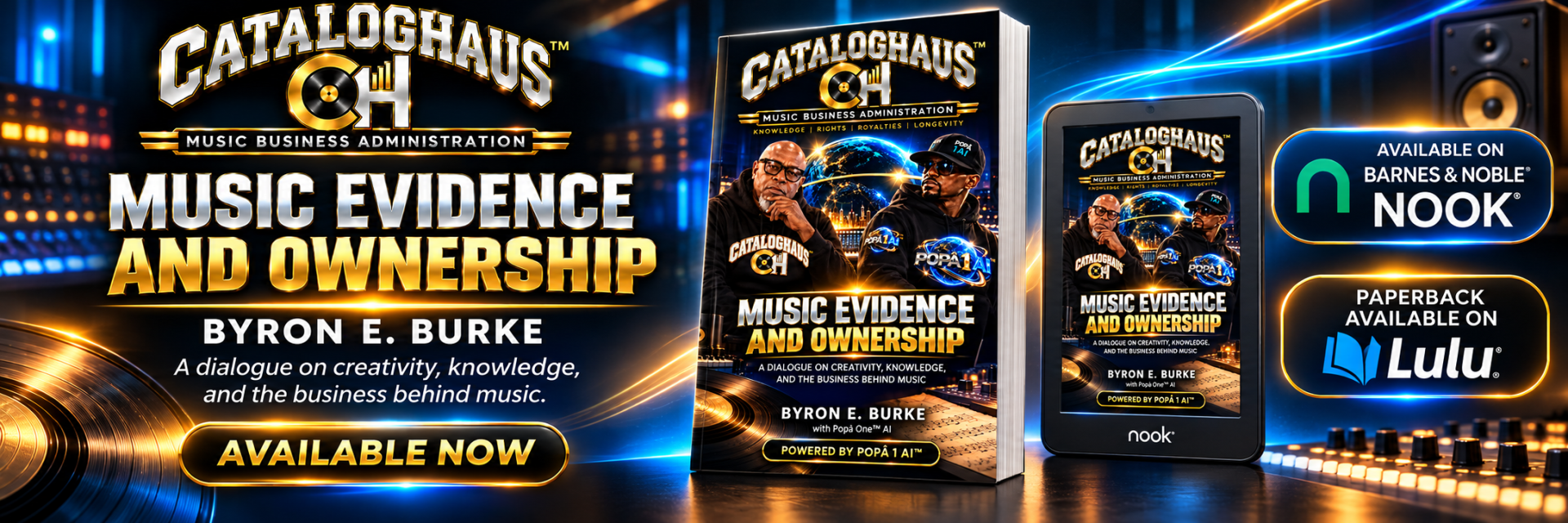

Books & Learning Resources
Music Evidence and Ownership — Expanded Revised Edition
Why Cataloghaus
Why Cataloghaus
Cataloghaus™ provides practical music-business education designed to help creators understand the systems behind their work—not just how to create music, but how to manage the business connected to it.
COMMON QUESTIONS
FAQ
You have questions, we have answers
Who is Cataloghaus for?
Cataloghaus is designed for artists, songwriters, producers, DJs, managers, publishers, and independent music entrepreneurs who want a stronger understanding of the business systems behind music.
What will I learn?
Cataloghaus focuses on practical areas including metadata, rights and ownership, royalties, licensing, documentation, catalog administration, and long-term music-business infrastructure.
Do I need music-industry experience?
No. Cataloghaus is designed to make complex music-business concepts understandable while also providing practical value for people who already have industry experience.
How are the courses delivered?
Cataloghaus learning experiences are designed for online education through structured lessons, resources, and practical activities. Specific course availability and enrollment details are provided with each program.
Is Cataloghaus a royalty collection organization?
No. Cataloghaus is an independent music-business education and catalog-administration training platform. It teaches creators how royalty systems, registrations, metadata, and catalog records work. Cataloghaus does not register works, does not collect royalties, and does not guarantee income or recovery. Cataloghaus is not affiliated with, endorsed by, or a replacement for ASCAP, BMI, SoundExchange, or any other royalty-administration organization. When you are ready to register or collect, you work directly with those organizations; Cataloghaus teaches you how to prepare for that work.
What is SoundExchange?
SoundExchange is the organization designated by the U.S. government as the sole administrator of the Section 114 sound recording license. It collects digital performance royalties for sound recordings played by non-interactive digital services — such as SiriusXM, Pandora's radio-style service, iHeartRadio, and internet webcasters — and distributes those royalties to featured artists and sound recording rights owners. Rates under the statutory license are set through the federal Copyright Royalty Board process. Official source: https://www.soundexchange.com/
What is the difference between SoundExchange and a performing rights organization like ASCAP or BMI?
They cover two different sides of the same recording. SoundExchange covers the sound recording itself — the master — and only for digital, non-interactive plays under the statutory license. ASCAP and BMI cover the underlying composition — the song as written — when it is publicly performed. One released track can therefore generate both kinds of royalties, through different organizations. Cataloghaus teaches creators to track both sides separately, so each stream can be pursued through the right organization.
Who should register with SoundExchange, and how are royalties split?
Register in each capacity that applies to you: as a featured performer, as a sound recording rights owner, or both. Independent artists who own their masters register in both capacities. For royalties collected under the Section 114 statutory license, the law allocates 50% to the sound recording copyright owner, 45% directly to the featured artist or artists, and 5% to non-featured performers — 2.5% to non-featured musicians and 2.5% to non-featured vocalists — through funds associated with AFM and SAG-AFTRA. The featured artist's 45% is paid directly by SoundExchange and does not pass through a label's accounting, but only for registered artists with claimed recordings, so keep your ISRCs consistent and claim your recordings in your account. Registration and recording claims facilitate payment and matching; they do not create the underlying statutory entitlement, which arises under the Section 114 license itself. A featured artist must register separately from their label to receive the 45% share directly. Plays covered by a separate direct license between a service and a rights owner fall outside the statutory system. Registration is free; check the official site for current registration steps. Official source: https://www.soundexchange.com/
Does SoundExchange collect royalties from Spotify or Apple Music?
No. Spotify and Apple Music are interactive services, where the listener chooses the exact song. They do not pay through SoundExchange's Section 114 license. SoundExchange also does not cover terrestrial (AM/FM) radio in the United States, which does not pay a sound recording performance royalty. If your music is played on non-interactive digital services, that is the SoundExchange lane; interactive streaming and other uses pay through different channels.
What is ASCAP?
ASCAP — the American Society of Composers, Authors and Publishers — is a performing rights organization (PRO) founded in 1914. It represents songwriters, composers, and music publishers, licenses public performances of their musical works, collects performance royalties, and distributes them to its writer and publisher members. ASCAP is the only performing rights organization in the United States that operates on a not-for-profit basis, and it is governed by its songwriter, composer, and publisher members. It reports more than 1.1 million members. Official source: https://www.ascap.com/
What does ASCAP collect?
ASCAP collects performance royalties for the composition — the song as written — when it is publicly performed. That includes terrestrial and satellite radio, television, live venues, streaming services, and businesses that play music publicly. ASCAP does not collect royalties for the sound recording itself (that is SoundExchange's digital lane), and it does not collect mechanical royalties. A songwriter's performance royalties are typically divided between a writer share and a publisher share.
Can I join ASCAP and BMI at the same time?
As a songwriter, you affiliate with one performing rights organization at a time for your writer share. Switching organizations later is possible, but it is governed by the terms of the agreement you signed, which may include notice periods — so compare current terms on the official sites before affiliating. Publisher affiliation is separate: a single publishing entity affiliates with one PRO, but a publisher may operate separate publishing entities affiliated with different PROs, which is how publishers representing writers at both organizations are structured. If you are both the writer and the publisher of your songs, the simplest arrangement is usually the same PRO for both, but the writer and publisher affiliations remain distinct accounts. Each co-writer on a song affiliates independently, and each PRO pays its own affiliated writers their shares. Register your works with the organization you choose, so your performances can be reported and matched for potential payment; registration does not by itself guarantee payment. Official sources: https://www.ascap.com/ · https://www.bmi.com/
What is BMI?
BMI — Broadcast Music, Inc. — is the largest performing rights organization (PRO) in the United States. It represents more than 1.5 million songwriters, composers, and publishers, and licenses a catalog of more than 25 million musical works. Like ASCAP, BMI licenses public performances of compositions and distributes performance royalties to its affiliated writers and publishers. BMI was founded in 1939 and now operates as a for-profit company; older articles describing it as a nonprofit are outdated. Official source: https://www.bmi.com/
What does BMI collect?
BMI collects performance royalties for the composition when it is publicly performed — on radio, television, in venues and businesses, and through streaming services. BMI does not collect royalties for the sound recording itself, and it does not collect mechanical royalties. If you write songs and also own your masters or perform on the recordings, your composition royalties through BMI are a separate stream from any recording royalties through SoundExchange.
How do I choose between ASCAP and BMI?
Both organizations perform the same core job: license public performances of your compositions and pay performance royalties. They differ in structure and governance — ASCAP is a member-governed not-for-profit, while BMI is now a for-profit company — and in membership terms, tools, and payment practices, which change over time. The same affiliation rules apply: as a songwriter you affiliate with one PRO at a time, while publisher affiliation is a separate matter (see the ASCAP answer above). Compare the current terms on ascap.com and bmi.com, then affiliate and register your works. Registration is what allows your performances to be reported and matched; it does not by itself guarantee payment. Official sources: https://www.ascap.com/ · https://www.bmi.com/
Why do I need more than one registration?
Because one song is more than one right. A released track involves at least two copyrights — the composition and the sound recording — and several royalty lanes: public performance (ASCAP or BMI), digital performance of the recording (SoundExchange), mechanical royalties (in the U.S., certain digital mechanical royalties are administered by The MLC under the Section 115 blanket license for digital music providers; The MLC does not administer every mechanical royalty), and synchronization, which is usually licensed directly. No single organization collects everything, and a distributor is not a substitute for any of them: a distributor delivers your recording to streaming platforms and accounts for master revenue from those platforms, but it does not replace a PRO, SoundExchange, or The MLC. Cataloghaus teaches creators to map each track across every lane, so every lane is addressed.
Does Cataloghaus replace ASCAP, BMI, or SoundExchange?
No. Cataloghaus is an education and training platform, not a collection organization and not an agent for any of them. Cataloghaus courses, including Music Business Administration Foundations, and tools like the Track & Writer Starter Pack and the Catalog Health Check, help you organize metadata, document ownership and splits, and understand registrations and royalty pathways. Actual registration, licensing, collection, and payment happen directly between you and the organizations above. Cataloghaus provides education only — not legal advice, not a royalty audit, not an ownership determination, and not a guarantee of income or recovery.
Created with